
Article: Could Your Haircare Be Contributing to Your Eczema? 3 Ingredients to Know
Could Your Haircare Be Contributing to Your Eczema? 3 Ingredients to Know
Does this sound familiar? You’ve tried countless haircare products, and your scalp still feels itchy or irritated. You’ve tried natural formulas, hypoallergenic options, and even products your dermatologist recommended. Where do you go from here?
One place to start is the ingredient list. Three ingredients used in haircare—cocamidopropyl betaine, methylisothiazolinone, and benzyl alcohol—can cause contact allergy in some people.
Each has been named Allergen of the Year by the American Contact Dermatitis Society (ACDS), in 2004, 2013, and 2026, respectively. That doesn’t mean everyone needs to avoid them, but they’re worth discussing with your dermatologist if your scalp irritation persists.
For Eczema Awareness Month, we’re taking a closer look at what these ingredients do, what the research shows, and why they may matter for your routine.
Who is the ACDS, and why does its work matter?
Founded in 1989, the ACDS is a professional organization dedicated to improving the understanding, diagnosis, and care of dermatitis through education, research, and advocacy. Its work helps clinicians recognize allergens that might otherwise be overlooked and helps patients make more informed choices about products that touch their skin.
This matters because an allergic reaction to a product can resemble, or coexist with, atopic dermatitis, the condition many people mean when they say “eczema.” Identifying a contact allergen can help explain why a rash keeps returning.
The ACDS’s annual Allergen of the Year designation draws attention to substances that deserve greater awareness. It isn’t a ranking of the most dangerous ingredients or a recommendation that everyone avoid them.
A note about the research: Most statistics below come from patients referred for allergy patch testing, rather than the general population. These figures don’t represent your personal risk of allergy, and a dermatologist must interpret whether a positive result explains your symptoms.

1. Cocamidopropyl betaine: a common cleanser with an important nuance
ACDS Allergen of the Year: 2004
Cocamidopropyl betaine, often shortened to CAPB, is a common cleansing and foaming ingredient used in shampoos, body washes, and liquid soaps. It can be relatively mild in terms of irritation, but mildness does not rule out contact allergy.
What does the research show?
A North American study of 10,877 patients patch tested between 2009 and 2014 reported positive reactions to CAPB in 1.4%. [1]
A smaller study looked at people who had previously tested positive to CAPB. Seven of the 10 participants developed dermatitis while using CAPB-containing products. Because these participants were already selected for suspected allergy, this finding does not mean 70% of people will react to CAPB. [2]
Why can it cause a reaction?
Sometimes the culprit appears to be residual substances from manufacturing, such as amidoamine or dimethylaminopropylamine (DMAPA), rather than purified CAPB itself. [2,3]
In the smaller study, six of the nine participants who underwent follow-up patch testing reacted to amidoamine. None reacted to the amidoamine-free CAPB preparation used in follow-up testing. These findings support an important role for manufacturing impurities, while not ruling out rare allergy to CAPB itself. [2]
What to look for: “Cocamidopropyl betaine” on the ingredient list. If your dermatologist suspects it, testing related manufacturing substances may help clarify the cause. The ingredient name alone does not reveal the purity of a particular formula.

2. Methylisothiazolinone: a preservative with a significant allergy history
ACDS Allergen of the Year: 2013
Methylisothiazolinone, or MI, is a preservative used to help prevent microbial growth. It has been used in personal care products, household products, and industrial products. You may also see it alongside methylchloroisothiazolinone, abbreviated MCI.
What does the research show?
A 2023 study comparing North American and European patch-test databases found that 15.0% of North American patients tested for MI in 2017–2018 reacted positively, compared with 5.5% and 3.4% in two European surveillance networks. These are historical figures from patients referred for testing, not current population allergy rates. [4]
A later study of 2,554 patients tested across participating European centers in 2022 found MI allergy in 2.9%. Its authors described the earlier surge in MI allergy and subsequent European restrictions on its use in cosmetics. [5]
Together, these studies show why MI has received substantial attention from contact allergy researchers. They also show why the location, timing, and population behind an allergy statistic matter.
Why can it cause a reaction?
Contact allergy develops when the immune system becomes sensitized to a substance and reacts on later exposure. Laboratory research using reconstructed human skin found that MI reacts with specific chemical groups in skin proteins, helping researchers understand the chemistry involved in sensitization. [6]
For someone who has become allergic, exposure can trigger an itchy, inflamed rash.
What to look for: “Methylisothiazolinone” and “methylchloroisothiazolinone” on ingredient lists. If you have a confirmed allergy, your dermatologist can help you identify relevant exposures beyond haircare, too.

3. Benzyl alcohol: an uncommon allergen worth recognizing
ACDS Allergen of the Year: 2026
Benzyl alcohol can serve as a preservative, solvent, or fragrance ingredient. It is found in some personal care products and topical medications. Its function in a formula is not always fragrance, so checking the complete ingredient list matters. [10]
What does the research show?
In a large study of 70,867 patients tested between 2010 and 2019, 146—0.21%—had a positive reaction to benzyl alcohol tested at 1% in petrolatum. Most positive reactions were weak, and positive results were not consistently reproduced on repeat testing. The researchers concluded that sensitization was very rare in their dataset. [7]
Benzyl alcohol therefore has a different allergy profile from MI. It is a possible individual trigger, but this research does not support presenting it as a common cause of contact allergy.
Why can it cause a reaction?
Benzyl alcohol is considered a weak sensitizer, meaning it has a relatively low ability to induce contact allergy. Nevertheless, it can provoke delayed allergic contact dermatitis in susceptible people. [8]
Published reports have linked reactions to personal products, including a case discussed in a 2005 paper and a 2026 report involving moist toilet paper. These reports demonstrate that meaningful reactions can happen, but they do not establish how frequently they occur. [8,9]
The ACDS selected benzyl alcohol for 2026 to raise awareness of its potential to cause allergy and encourage appropriate testing when it is suspected. [10]
What to look for: “Benzyl alcohol” on the ingredient list. It may not be included in a standard patch-test panel, so ask your dermatologist whether additional testing would be appropriate. [10]
What this means for your routine
Knowing an ingredient can cause allergy is a starting point. It does not establish that it is causing your symptoms, and irritation is not the same as allergy.
If your scalp or skin keeps flaring, a dermatologist can assess whether contact allergy may be contributing and whether patch testing is appropriate. Bring a list of your shampoos, conditioners, styling products, and topical treatments so the evaluation reflects what you actually use.
You don’t need to eliminate every ingredient that could potentially cause a reaction. The goal is to understand your own triggers and build a routine that works for your skin.
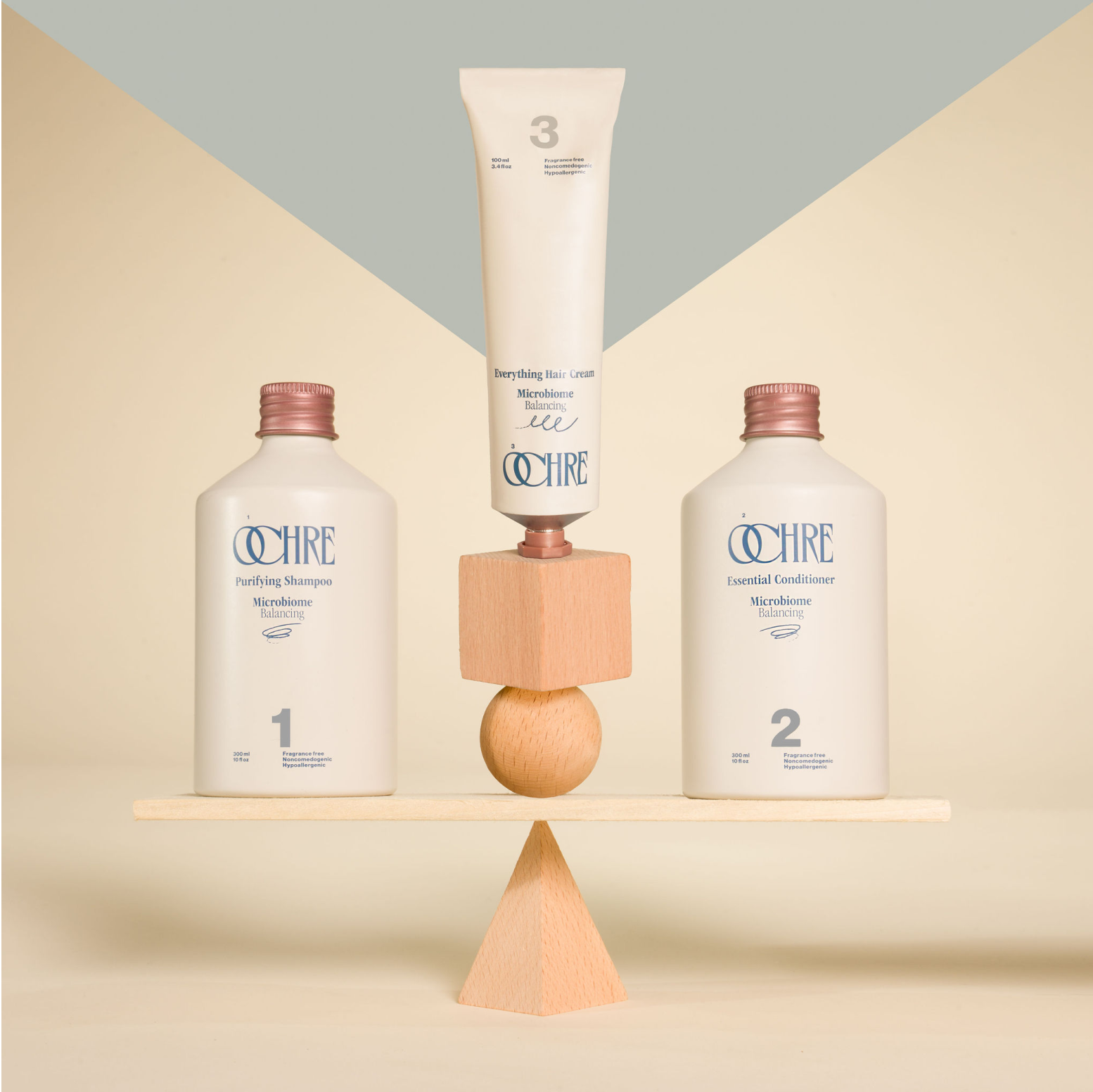
At OCHRE, our products are purposely formulated without using cocamidopropyl betaine, methylisothiazolinone, and benzyl alcohol. Our exclusion lit contains over 1,000+ ingredients that may do more harm than good. You can see the full exclusion list here.
Sources
Cocamidopropyl betaine
- Fowler JF Jr, et al. Cutaneous Delayed-Type Hypersensitivity to Surfactants. Dermatitis. 2015;26(6):268–270. Retrospective patch-test study. Read the study.
- Fowler JF, Fowler LM, Hunter JE. Allergy to cocamidopropyl betaine may be due to amidoamine: a patch test and product use test study. Contact Dermatitis. 1997;37(6):276–281. Small product-use and patch-test study. Read the study.
- Moreau L, Sasseville D. Allergic contact dermatitis from cocamidopropyl betaine, cocamidoamine, 3-(dimethylamino)propylamine, and oleamidopropyl dimethylamine: co-reactions or cross-reactions? Dermatitis. 2004;15(3):146–149. Case report. Read the paper.
Methylisothiazolinone
- Reeder MJ, et al. Trends in the Prevalence of Methylchloroisothiazolinone/Methylisothiazolinone Contact Allergy in North America and Europe. JAMA Dermatology. 2023. Retrospective analysis of surveillance databases. Read the study.
- Current frequency of contact allergy to isothiazolinones (methyl-, benz- and octylisothiazolinone) across Europe. Contact Dermatitis. 2024. Multicenter cross-sectional audit. Read the study.
- In situ chemical behaviour of methylisothiazolinone (MI) and methylchloroisothiazolinone (MCI) in reconstructed human epidermis: a new approach to the cross-reactivity issue. Contact Dermatitis. 2016. Laboratory study. Read the study.
Benzyl alcohol
- Geier J, et al. Is benzyl alcohol a significant contact sensitizer? Journal of the European Academy of Dermatology and Venereology. 2022;36(6):866–872. Retrospective patch-test study. Read the study.
- Curry EJ, Warshaw EM. Benzyl alcohol allergy: importance of patch testing with personal products. Dermatitis. 2005;16(4):203–208. Case report with review. Read the paper.
- Martínez Rozas L, et al. An Unexpected Culprit: Allergic Contact Dermatitis Caused by Benzyl Alcohol in Moist Toilet Paper. Contact Dermatitis. 2026;95(1):113–115. Case report. Read the paper.
- Le NT, Wu PA. Benzyl Alcohol: Allergen of the Year 2026. Dermatitis. 2026;37(1):4–12. Peer-reviewed background article. Read the paper.
ACDS background and designations
- American Contact Dermatitis Society. Mission and Values. Learn about ACDS.
- Jacob SE, Amini S. Cocamidopropyl betaine. Dermatitis. 2008;19(3):157–160. Includes the 2004 designation. Read the review.
- SmartPractice Allergen Bank. Allergen of the Year Timeline. Lists the ACDS selections, including MI in 2013. View the timeline.
- American Contact Dermatitis Society. Spring 2026 Newsletter. Includes the benzyl alcohol announcement. Read the newsletter.