


Article: What Is PAR Formula™? The Science Behind OCHRE's Approach to Scalp Health
What Is PAR Formula™? The Science Behind OCHRE's Approach to Scalp Health
What Is PAR Formula™?
Whenever my scalp became itchy or flaky, I'd reach for a drugstore medicated shampoo.
It usually worked for a while, but relief often came at the expense of my hair.
My scalp would feel dry, my hair felt stripped, and over time I'd find myself rotating between different treatments as one seemed to become less effective.
When we started OCHRE, we weren't interested in creating another medicated scalp care line or another "clean" haircare brand. We wanted to understand a much bigger question:
What actually makes a scalp healthy?
That question led us down a rabbit hole of reading hundreds of scientific papers on the scalp barrier function, inflammation, dandruff, seborrheic dermatitis, psoriasis, and cosmetic chemistry.
Along the way, one idea kept resurfacing: a balanced scalp microbiome plays a central role in maintaining a healthy scalp.
When people ask me what makes OCHRE different, it’s difficult to pinpoint just one thing.
I spend a lot of time thinking about the allergens, irritants, and fungus-feeding ingredients I don't want in our products. But I spend just as much time thinking about the ingredients I do want to include.
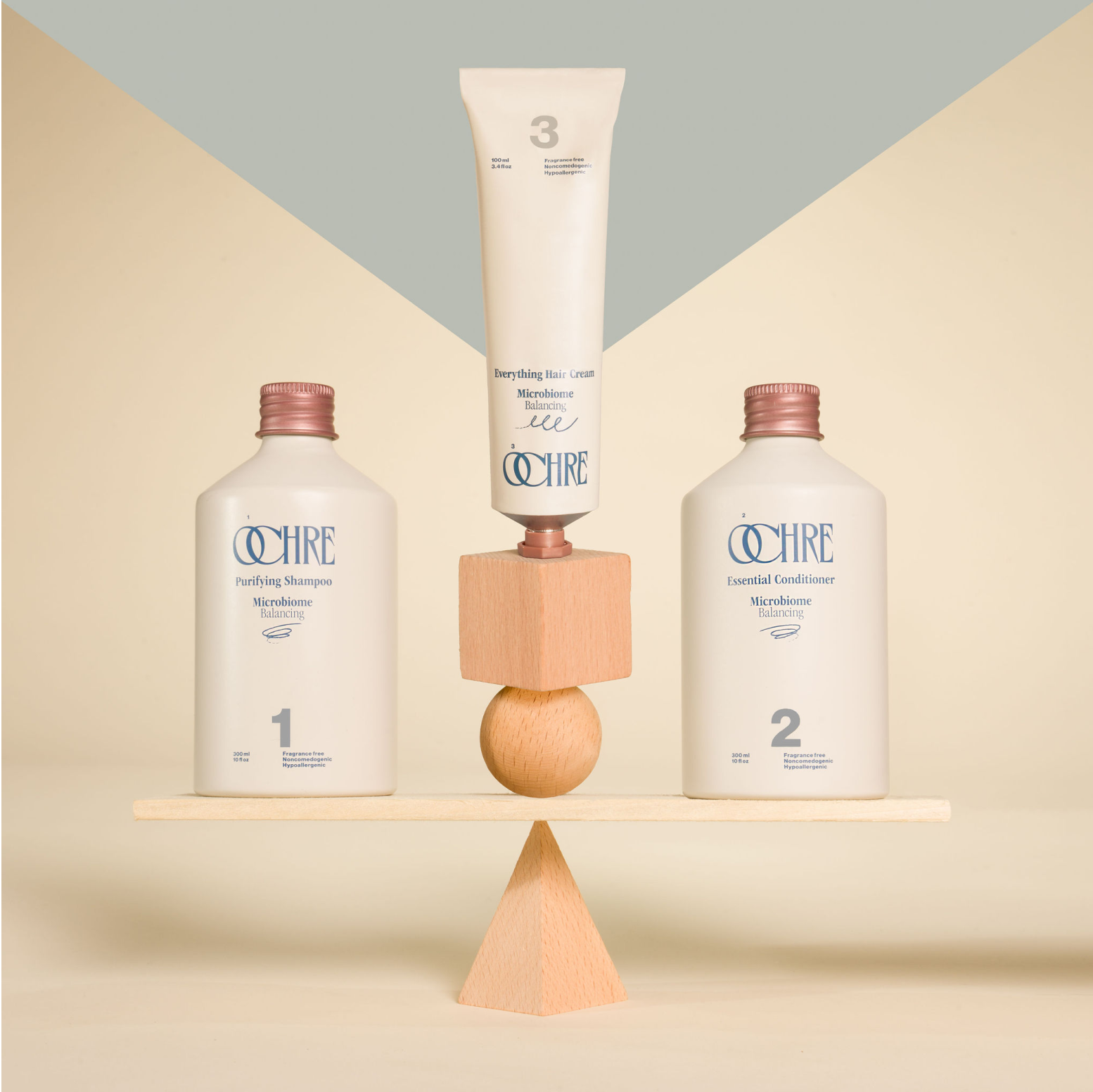
Those ingredients became PAR Formula™, our proprietary blend of Plant Esters, Algae Extract, and Rosebay Extract, found in every OCHRE product.
Each ingredient was selected to support a different aspect of scalp health—from microbial balance and skin barrier function to regulating excess oil and inflammation.
Why We Focus on the Scalp Microbiome
Your scalp is home to billions of bacteria, fungi, and yeast that together make up what's known as the scalp microbiome.
Just like the microbiome in your gut, these microorganisms play an important role in keeping your skin healthy (you can red more about it here).
When that ecosystem is balanced, your scalp is generally able to regulate itself. But when it becomes disrupted, it can contribute to visible flakes, irritation, itchiness, excess oil, and sensitivity.
Many traditional scalp treatments work by aggressively suppressing microorganisms.
Those products absolutely have their place, especially for people managing more severe scalp conditions. But as I continued my research, I became increasingly interested in another approach: supporting the scalp's own ecosystem so it can function the way it's designed to.
That's the philosophy behind PAR Formula™.
Plant Esters: A Trojan Horse
The first ingredient in PAR Formula™ is Propanediol Caprylate, a lightweight plant-derived ester.
It's not a trendy ingredient you'll see all over social media, and I'd never heard of it before I started researching scalp microbiome science.
But after digging through the published research, I became convinced of its potential.
One of the things that fascinated me most is how it appears to interact with Malassezia, a yeast commonly associated with dandruff and scalp irritation.
Malassezia naturally feeds on oils found on the scalp, particularly long-chain triglycerides. Propanediol Caprylate was designed to resemble those oils. As the yeast metabolizes the ingredient, it releases medium-chain fatty acids that Malassezia cannot effectively utilize.
I've always thought of it as a bit of a Trojan horse.
Instead of simply trying to eliminate microorganisms, it appears to work with the biology of the scalp to help regulate microbial balance.
The results is what ultimately sold me.
In a 30-day shampoo study, formulations containing 0.5% Propanediol Caprylate significantly reduced visible dandruff compared to placebo and performed similarly to established anti-dandruff ingredients like piroctone olamine.
Researchers also observed a shift toward a healthier scalp microbiome, including reductions in Staphylococcus populations and increases in Cutibacterium, microorganisms more commonly associated with healthy scalps.
Ex vivo testing further demonstrated up to a 39% reduction in sebum production, suggesting it may also help regulate excess scalp oil that contributes to scalp imbalance.
Algae Extract: A Scalp Superfood
The second ingredient in PAR Formula™ is Chlorella Vulgaris Extract, a sustainably cultivated Mediterranean green microalgae.
I'll admit, the first time I saw it described as a "scalp superfood," I rolled my eyes a little.
However, this ingredient had a lot of clinical research to back it.
Unlike many scalp ingredients that focus on removing oil or suppressing microbes, this bioactive works by nourishing the scalp ecosystem.
It's rich in barrier-supporting polysaccharides that act as a prebiotic, helping support beneficial microorganisms while creating an environment that's less favorable for microbial imbalance.
What also drew me to this ingredient is how it's produced.
It's cultivated in freshwater tanks using upcycling technology developed at the University of Barcelona. Unlike many marine algae extracts, it contains no iodine, making it a thoughtful choice for acne-prone skin.
The research behind the ingredient was impressive.
In a 28-day shampoo study, participants experienced up to a 36.5% reduction in scalp sebum compared to placebo.
Participants also reported a 90% improvement in scalp itchiness over the same period.
Laboratory studies demonstrated 52% inhibition of Malassezia furfur—one of the yeasts commonly associated with dandruff—while increasing markers associated with skin renewal and barrier repair by 171%.
To me, that represented something bigger than simply reducing symptoms. It suggested an ingredient that helps create the conditions for a healthier scalp over time.
Rosebay Extract: A Historic Botanical
The final ingredient in PAR Formula™ has one of the longest histories of therapeutic use.
Rosebay Extract (also known as Willowherb or Fireweed) has been used therapeutically for more than 160 years to help soothe irritated skin.
Our extract is sustainably wild-harvested from the Canadian prairies and standardized in Oenothein B, a naturally occurring polyphenol that's been studied for its anti-inflammatory and sebum-regulating properties.
In general, I believe botanicals are best avoided in products designed for sensitive scalps. However, what drew me to Rosebay is that it supports several aspects of scalp health simultaneously.
Instead of relying primarily on antimicrobial activity, it has been studied for its ability to help regulate excess sebum, calm inflammation, strengthen the skin barrier, and support a healthier scalp environment.
The clinical research behind this ingredient is surprisingly extensive.
In scalp studies, participants using shampoos containing Rosebay Extract at 0.5% experienced up to a 67% reduction in excess scalp oil after 30 days.
Clinical testing also demonstrated a 52–54% reduction in visible dandruff flakes, with measurable improvements beginning after the very first use.
Laboratory studies showed approximately an 80% reduction in inflammatory markers such as IL-8, alongside increased expression of involucrin, a protein associated with a stronger skin barrier.
Why We Combine All Three
Each ingredient in PAR Formula™ contributes something different.
- Plant Esters help support microbial balance.
- Algae Extract helps nourish the scalp barrier and microbiome.
- Rosebay Extract helps calm inflammation while regulating excess oil.
Individually, they're fascinating ingredients. Together, they represent how we think about scalp health. We aren't trying to sterilize your scalp. We're trying to support a balanced one.

Why Every Ingredient Is Included at 0.5%
Have you ever turned over a shampoo bottle and wondered why the ingredient list seems to go on forever?
Not every ingredient is there for the same reason. Some help cleanse, condition, preserve, or stabilize the formula. Others are included because they're trendy or make for good marketing, even if they're only present in very small amounts with no clinical benefit.
Our approach is a bit different. You may notice that each ingredient in PAR Formula™ is included at 0.5%.
Although 0.5% may sound like a small amount, these are highly concentrated bioactive ingredients.
We selected this concentration because it aligned with the published research for efficacious levels. While every finished formula behaves differently, we believed it was important to formulate at levels supported by the available evidence rather than simply include an ingredient for its name on the label.
Science Beyond PAR Formula™
As important as PAR Formula™ is, I don't believe it's solely responsible for how OCHRE performs.
In many ways, what we leave out is just as important as what we put in.
As we developed OCHRE, we worked with dermatologists, allergists, formulators, and microbiome scientists while reviewing hundreds of scientific studies to create an exclusion list of more than 1,000 ingredients that we believed were more likely to contribute to irritation, allergic reactions, clogged follicles, or disruption of the scalp's natural balance.
As much as I'd love for there to be one miracle ingredient that solved everyone's scalp concerns, that's rarely how great formulations are built. They're often the result of hundreds of thoughtful decisions.
What We've Seen in Clinical Testing
While we don't attribute these results to PAR Formula™ alone, we're encouraged by what we've seen across our finished products.
Our clinical and consumer testing has shown:
- 87% of participants reported a more balanced scalp after two weeks.
- 83% reported their scalp felt healthier.
- 74% reported having less scalp irritation.
- 70% reported healthier-looking hair after just two weeks.
- 25% reduction in scalp comedones after two weeks of using Everything Hair Cream.
These findings reinforce something we've believed from the beginning: scalp care shouldn't require compromising the health or beauty of your hair.
Looking Ahead
When Chris and I started OCHRE, we were just trying to solve our own problem. We felt that modern, premium haircare wasn’t making the products that our sensitive scalps needed.
PAR Formula™ is one chapter of that story.
It's the result of countless hours spent challenging assumptions, reading research papers, and looking for ingredients that support the scalp rather than fight against it.
The science around the scalp microbiome is still evolving, and we'll continue learning alongside it. But I know one thing will never change:
Healthy hair starts with a healthy scalp.
That's the philosophy behind PAR Formula™, and it's the philosophy that continues to guide every product we create.
Sources
- Ailus, J.; Saleem, I.; Ismail, F.M.D. A Review of the Anti-Inflammatory Skincare Potential ofEpilobium angustifolium(Fireweed) Inspired by Herbal Tradition.Cosmetics 2024,11, 156. https://doi.org/10.3390/cosmetics11050156
- Byrd AL, Belkaid Y, Segre JA. The human skin microbiome. Nat Rev Microbiol. 2018;163:143–55.
- Mayser, P.; Genrich, F.; Meunier, L.; Nordzieke, S. Scalp Microbiome and Dandruff—Exploring Novel Biobased Esters.Cosmetics 2024,11, 174. https://doi.org/10.3390/cosmetics11050174
- Schepetkin IA, Ramstead AG, Kirpotina LN, Voyich JM, Jutila MA, Quinn MT. Therapeutic Potential of Polyphenols from Epilobium Angustifolium (Fireweed). Phytother Res. 2016 Aug;30(8):1287-97. doi: 10.1002/ptr.5648. Epub 2016 May 24. PMID: 27215200; PMCID: PMC5045895.
- Sibi D, Silvanose CD, Jibin VG. Role of Malassezia furfur and M. globosa in Dandruff and Seborrheic Dermatitis. J Clin Investigat Dermatol. 2023;11(1): 2

